 Geistfinance
 collateral
Geist Finance used deposited assets to secure ongoing loans on Fantom. Multichain-bridged collateral depegged in July 2023 while the protocol’s Chainlink feeds continued tracking underlying-asset prices. The resulting valuation gap was central to the team’s July 14, 2023 decision not to reopen lending and borrowing.
· last updated
Bridged assets and deposit claims
For ongoing loans, Geist used overcollateralized borrowing. The collateral affected by the Multichain losses included bridged versions of USDC, USDT, WBTC, and ETH on Fantom. Their value depended on the backing and exchangeability of those particular bridged tokens.
What a gToken represented
The Fantom Foundation’s October 27, 2021 profile described deposits as having corresponding interest-bearing gTokens, pegged 1:1 to the value of the underlying deposited asset. That relationship described a deposit claim. A claim representing a Multichain-bridged asset remained exposed to the value of that asset; receipt-token accounting could not restore missing bridge backing.
The pricing gap in July 2023
The expected 1:1 exchange between Multichain tokens and the assets they represented had supported the use of underlying-asset price feeds. After the bridge losses, the Multichain versions traded at a substantial discount. In its July 14, 2023 announcement, the Geist Finance team estimated the affected tokens were trading at about 22% of the corresponding underlying assets’ value. That percentage described market conditions at the time of the announcement.
Chainlink feeds continued measuring the underlying USDC, USDT, WBTC, or ETH. They did not measure the discounted Multichain versions held on Fantom. The Geist team stated that the oracles had worked as intended: a correct price for the reference asset could still overstate the value of its damaged bridged representation.
Bad-debt exposure for other lenders
Reopening borrowing at those reference valuations would have allowed lower-value bridged collateral to support loans of unaffected assets. Geist identified lenders of FTM and Magic Internet Money (MIM) as exposed to bad debt. The threatened shortfall therefore extended beyond holders of the depegged collateral to suppliers of the assets borrowers could take from the pools.
A hypothetical collateral revaluation
All balances and prices in this example are hypothetical. A reviewer is reconciling a historical Geist borrowing record on Fantom containing 1,238 Multichain-bridged USDC tokens used as collateral. At the same assumed valuation time, underlying USDC has a reference price of $1.00 per token, and the bridged token has a market quote of $0.22 per token. The reviewer retains the original account record and compares the valuations in a separate worksheet.
| Valuation action | Price used, USD per token | Collateral estimate, USD |
|---|---|---|
| Apply the underlying-USDC reference price | 1.00 | 1,238 × 1.00 = 1,238.00 |
| Revalue using the bridged-token quote | 0.22 | 1,238 × 0.22 = 272.36 |
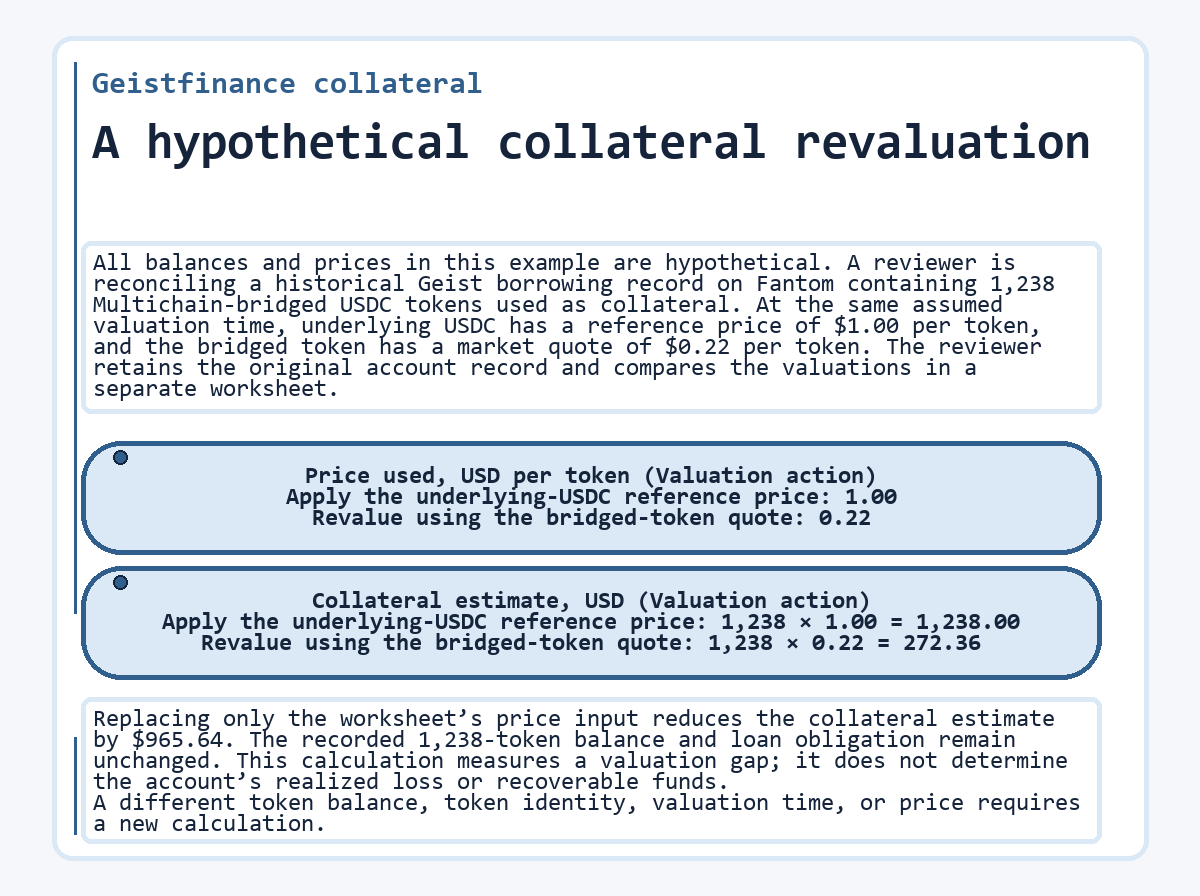
Replacing only the worksheet’s price input reduces the collateral estimate by $965.64. The recorded 1,238-token balance and loan obligation remain unchanged. This calculation measures a valuation gap; it does not determine the account’s realized loss or recoverable funds.
A different token balance, token identity, valuation time, or price requires a new calculation.
Limits of a legacy collateral balance
Geist paused its contracts on July 6, 2023, and reenabled withdrawal and repayment functions on July 9, 2023. The July 14 closure announcement ruled out reopening lending and borrowing. Present-day withdrawal access cannot be inferred from that historical reopening.
A recorded collateral balance identifies token units. It does not establish equivalent bridge backing, current market liquidity, or a realizable value at the underlying asset’s reference price.